

Introduction
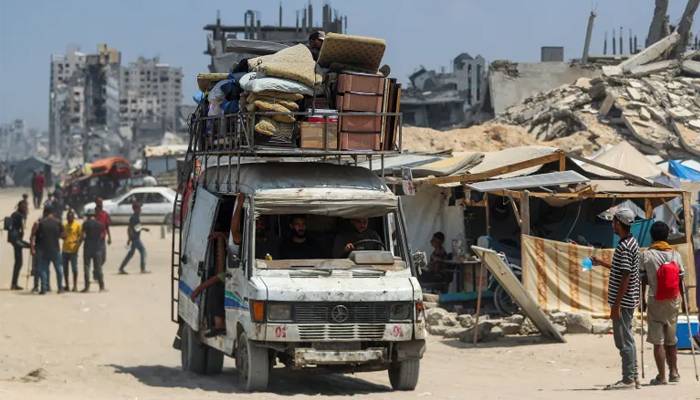
Shockwaves went through the world after Israel Prime Minister Benjamin Netanyahu said that he needed to seize Gaza City if its inhabitants did not restore an Israeli capture it has been wanting. This plan has been widely denounced as a "starve or leave" policy, a new and devastating humanitarian catastrophe that entails uprooting the local population and creating a "security perimeter."
Reaction of Foreign Governments
Foreign governments, including some of Israel's allies, have criticized the move globally, calling it a breach of international law and a kind of collective punishment. However, the United States' response to this global uproar is still a study in ambiguity, underscoring a long-standing trend of steadfast support for Israel.
US Response
The US government's stance on this most recent proposal is a clear example of a foreign policy that continuously puts Israel's interests ahead of the Palestinians'. The US response has been very different from other countries' unambiguous condemnation. In an interview with Fox News, for instance, a US vice president reportedly said that Washington acknowledged "a lot of downsides and upsides" but neither approved nor rejected the plan. This ambiguous position is a strong message, especially coming from a country that prides itself on upholding international law and human rights. It implies that the US is not ready to take a strong stance against its ally in spite of the humanitarian catastrophe that is developing.
US Indifference for Gaza
The obvious disparity between US foreign aid to Israel and the Palestinians is among the most obvious instances of this neglect. With billions of dollars in military aid given each year, Israel has received more US foreign aid than any other country since World War II. This aid is often unconditional, despite well-documented reports from humanitarian organizations and international bodies that Israeli military actions have resulted in widespread civilian casualties and the destruction of critical infrastructure in Gaza. On the other hand, although it has been substantial at times, US assistance to the Palestinians has frequently been a small portion of that provided to Israel and has been conditioned by a number of political factors, including the Taylor Force Act, which has limited aid to the Palestinian Authority.
In addition, the US has continuously protected Israel from international scrutiny by using its diplomatic influence. Resolutions that criticize Israeli policies, including those pertaining to the ongoing conflict and humanitarian crisis in Gaza, have been regularly blocked by the US using its veto power in the UN Security Council. Because of this diplomatic shield, Israel feels free to implement policies like the recent "starve or leave" plan for Gaza and the growth of settlements in the West Bank without worrying about the consequences on a global scale. Even though the US formally favors a two-state solution, its diplomatic actions frequently go against this position by not opposing policies that many believe directly prevent Palestinian statehood.
The US has also come under fire for its involvement in the actual humanitarian crisis. Although the US has given Gaza some humanitarian aid, its efficacy has been questioned. The United Nations and other aid organizations have condemned the establishment of the Gaza Humanitarian Foundation (GHF), an aid network supported by the United States and Israel. These organizations have charged the GHF with facilitating Israel's military goals, politicizing aid distribution, and fostering hazardous conditions for aid delivery that have resulted in civilian fatalities. Many people interpret this action as a US-sponsored attempt to replace long-standing UN-led coordination mechanisms and further strengthen Israeli government control over humanitarian access.
The people of Gaza suffer greatly as a result of the US's disregard and indifference. Widespread malnutrition, illness, and the almost complete breakdown of the healthcare system are the results of the ongoing humanitarian crisis. A large section of the population is experiencing food insecurity at crisis level or worse, according to reports from aid organizations, which warn of a man-made famine. Malnutrition and avoidable diseases are killing children, and the extent of the displacement has caused unfathomable human suffering.
Reasons for US Neglect
This behavior pattern is not new. The alliance between the United States and Israel has been solidified over decades by a complex web of political, historical, and strategic ties. Israel has been a vital strategic ally of the United States in the Middle East since its inception. It acted as a democratic safeguard against Soviet influence during the Cold War. It is now an essential counterbalance to regional rivals, especially Iran, and a vital partner in the fight against terrorism. Israel is now the biggest recipient of US foreign aid since World War II as a result of this strategic value, which has translated into enormous financial and military support.
A strong pro-Israel lobby in the US that has a big impact on American politics and public opinion serves to further cement this close alliance. Deeply embedded in the political discourse is the narrative of a shared democratic heritage and shared interests. Because of this, it has always been challenging for any US administration to oppose Israeli policies, even those that are widely denounced by the international community.
Therefore, the US's equivocal response to Netanyahu's new plan is a continuation of a long-standing policy rather than an exception. This policy aims to safeguard Israel's strategic interests and security, even if doing so comes at a high humanitarian cost. The Palestinians are left to bear the consequences of a policy known as "starve or leave" alone because, despite mounting international criticism, the one country that has the ability to actually affect Israel's actions is unwilling to do so.
----------------------
Writer: Umer Inam
A journalist based in New York, USA.
He shares posts on X as @UmerinamPk